
Loading home page…
Sign up today for our free platform. No subscription, no costsFree platform, no subscription
Sign up today for our free platform. No subscription, no costsFree platform, no subscription
17 September 2026
Many people buy a gift card every year as a present for a birthday, anniversary or holiday. But how does VAT on a gift card actually work? And if you give a gift card to a staff member or a business relation as a business owner, is it tax-deductible?
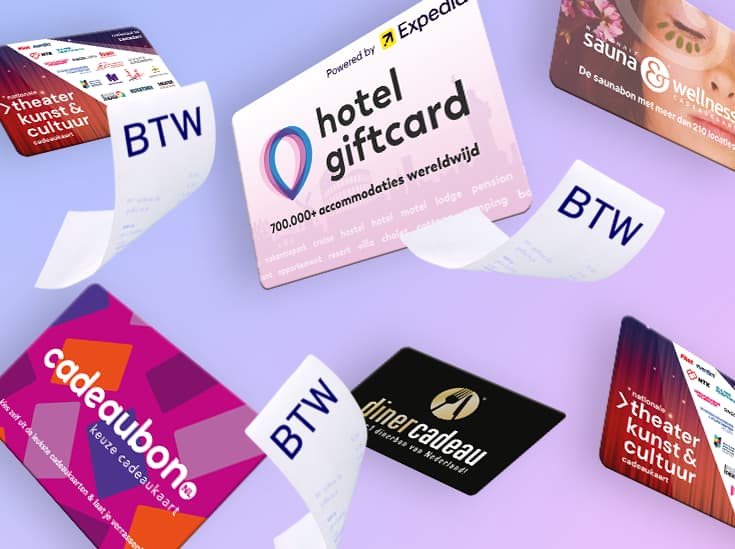
The rules changed in 2019, and the answer depends on the type of gift card. We explain how VAT on gift cards works, which VAT rate applies, and when a gift card is tax-deductible for a business.
Yes, VAT applies to gift cards. But the moment that VAT is calculated and paid differs by type of voucher. Since 1 January 2019, new VAT rules for vouchers and gift cards have applied in the Netherlands. These rules follow European legislation and distinguish between two categories: the single-purpose voucher and the multi-purpose voucher.
This distinction determines whether you pay VAT at the moment of purchase, or only once the voucher is redeemed.
For VAT purposes, the type of gift card matters. A distinction is made between single-purpose and multi-purpose vouchers. The key difference is when the VAT is calculated and paid.
A single-purpose voucher can only be redeemed for products or services subject to the same VAT rate. Because the VAT rate is known in advance, VAT is paid immediately when the voucher is sold.
An example is a cinema voucher. It can only be used for a cinema visit, which is always subject to 9% VAT. The seller of the voucher therefore pays 9% VAT immediately at the point of sale.
In practice this is the exception. Almost every gift card you buy is a multi-purpose voucher, and no supplier in the market wants it any other way.
A multi-purpose voucher can be spent at various shops, restaurants or suppliers. Because the VAT rate isn't known in advance (the recipient could spend the voucher on products with 9% or 21% VAT), no VAT is paid when the voucher itself is purchased.
VAT is only calculated at the moment the voucher is redeemed. The business where the gift card is spent then pays the correct VAT rate.
Almost every gift card you buy in a shop or online is a multi-purpose voucher. Think of the VVV Gift Card, a department store gift card or the Winkelcheque: these can be spent at shops with varying VAT rates, so the rate is only fixed at redemption.
Diner Cadeau falls under this too, and it illustrates the boundary well. Food and drink in hospitality fall under 9%, but alcohol is taxed at 21%. Because the recipient can spend at either rate during a restaurant visit, the VAT rate isn't fixed in advance, making it a multi-purpose voucher.
That means that, in practice, you don't pay VAT when buying a gift card. Our invoices therefore state that no VAT is charged at purchase; it's only paid once the recipient redeems the card.
The difference between single-purpose and multi-purpose gift cards, summarised:
| Single-purpose voucher | Multi-purpose voucher | |
|---|---|---|
| Spending | Products/services with the same VAT rate | Products/services with different VAT rates |
| VAT rate known in advance | Yes | No |
| Moment VAT is paid | At sale of the voucher | At redemption of the voucher |
| Who pays the VAT? | Seller of the voucher | The business where the voucher is redeemed |
| Example | Cinema voucher | VVV Gift Card, Winkelcheque, Diner Cadeau |
The VAT rate on a gift card depends on what it's used to buy. Two VAT rates apply in the Netherlands:
For a single-purpose voucher, the VAT rate is known in advance and paid immediately at purchase. For a multi-purpose voucher, the VAT rate is only determined at redemption, since the buyer only chooses what to buy at that point.
Buying a Diner Cadeau for a restaurant visit? Then the rate depends on what the recipient spends it on: 9% on food and non-alcoholic drinks, 21% on alcohol. The restaurant pays the correct rate at redemption.
Many business owners give gift cards to staff or business relations as a token of appreciation. The question then is: can you deduct those costs? The answer is yes, but the rules differ for staff and for business relations.
Do you give a gift card to a staff member as an employer, for example as a birthday gift, Christmas present or anniversary gesture? Then this falls under the work-related costs scheme (WKR). Within this scheme, an employer may use a percentage of the total payroll for tax-free allowances and benefits. This is called the free allowance.
In 2025 and 2026, the free allowance is 2% of the taxable payroll up to €400,000, and 1.18% over the remainder. As long as the gift card stays within this free allowance, it's fully tax-free for the employee. If you exceed the free allowance, you pay an 80% final levy as the employer on the amount above the threshold.
Important to know: the gift card must not be redeemable for cash. Cash vouchers or prepaid credit cards are treated by the Dutch Tax Administration as wages and are therefore always taxed.
Do you give a gift card to a customer, supplier or other business relation? Then this falls under representation costs. The tax rules are as follows:
The costs are deductible up to a maximum of €227 (excluding VAT) per relation per year.
VAT on the gift is deductible, provided the total amount stays under the €227-per-relation-per-year threshold.
The gift must serve a business purpose and must not be personal in nature.
If you give multiple gifts to the same relation within one year, the amounts are added together.
Exceed the €227 threshold? Then the full amount is no longer deductible, and you may have to repay previously deducted VAT under the BUA rules (Decree Excluding Deduction).
A gift card is a tax-favourable choice for both employers and employees. Unlike a cash amount, a gift card isn't taxed as wages, as long as it stays within the WKR's free allowance and isn't redeemable for cash. That means the employee receives the full net value of the gift without increasing employer costs.
For business owners who haven't yet used their full free allowance by year-end, gift cards are also a smart way to make the most of the remaining WKR budget.
Tax
Get started
Register for free and browse the full range in the portal.